
Nonprofit Revenue Streams: The Membership Engine
8 min read · Nonprofit Operations · Financial Planning

If you're building a membership program from scratch—or fixing a broken one—center on the value you're delivering and the people you serve.
Nonprofits know that membership programs can get complicated. The governance is not as simple as a donor tier, the value prop can be harder to nail down, and pricing decisions can be high-stakes. That complexity is often reason enough for early and mid-stage nonprofits to simply forgo membership programs as part of their revenue mix.
But when membership works, it really works. For nonprofits that have them, membership programs typically account for 15–30% of annual recurring revenue. That's a significant number in and of itself. A healthy membership base also contributes to growth, by boosting event sales, providing the social proof behind sponsorships and fundraising efforts, and even becoming an asset worth monetizing. A well-run membership program doesn't just generate its own revenue: it indirectly boosts revenue across your offerings.
So how do you build a program that actually works — or fix one that isn't? Our nonprofit Pros recently sat down to share what works, and how to avoid common pitfalls as you define your membership strategy. Learn how to:
Clarify the value prop for every tier of the membership program
Map membership to programming—and encourage both teams to own the numbers
Build a membership forecast based on retention metrics. Then, pull growth levers.
Put the Executive Director in the role of Chief Membership Officer to build a governance structure that drives clarity
Start with Value, Not Pricing
Memberships are transactional in a way that donor tiers are not. Someone who makes a gift to your organization doesn't necessarily expect something concrete in return — they believe in the mission, it feels good to give to a cause they are about, and they receive a tax benefit. That's enough.
A member, on the other hand, is making a value exchange. They want to know what they're getting from their dues, from the outset. When membership programs aren't deeply, fundamentally attuned to the value prop across target memberships, the program feels like a cash-grab. This means that nonprofits need a crystal-clear understanding of what they are delivering to members at every tier—and critically, you need to hear it from members themselves, not from your board.
Start with market research—that's a given. That looks like talking to current members, lapsed members, and the people you wish were members but haven't joined yet.
We also suggest assessing your programming map, and thinking through how the programs you already offer value in ways that align with the memberships you're trying to nurture. Think about how those programs can be differentiated either by size, company, or revenue band. For example, if your nonprofit provides a CTE that is required by a regulatory body, then you can easily start to define membership tiers based on the size and scale of the member entity.
The American Bar Association (ABA) offers a good example; their programming map includes continuing legal education (CLE), legislative advocacy, specialty practice resources, and professional development — and their membership tiers map directly onto that existing programming:
A law student member gets access to resources they need right now: job boards, mentorship, discounted bar prep. The programming already exists, and the membership tier packages it up.
A solo practitioner gets CLE credits, ethics guidance, and practice management tools — again, things the ABA already produces.
A large firm gets bulk CLE access, firm-wide compliance tracking, and legislative monitoring — more of the same programming, scaled to their context.
To our eyes, it doesn’t appear that ABA built three separate programs for three tiers, priced arbitrarily. Instead, they built one programming ecosystem and then asked: who uses which parts of this, and at what scale? The tier structure emerged from that conversation, and pricing followed.
Organizations that create tiers first, programming second, often end up with tiers that don't feel meaningfully different, or benefits that were invented to justify a price point rather than drawn from genuine organizational value. Members feel that gap, and will leave at renewal.
A few first principles:
Avoid one-size-fits-all. What a large corporate member needs from your organization is different from what an individual member needs. Pricing and benefits should reflect that.
Offer three tiers. Research from the Stanford Social Innovation Review supports what experience confirms: three options perform better than two or four. Give people a clear entry point, a mid-tier, and a premium option.
Every tier must advance the mission. A membership program that undermines your organizational purpose — even subtly — will erode trust from the inside.
Don't forget the pipeline play. Student and emerging professional tiers may not always look like a meaningful revenue contributor, but done right, they are an investment in the people who will become full-price members, volunteers, advocates, and donors.
"Networking" is not a value prop. Vague benefits don't sell memberships. Communicate program and membership value specifically. Say: "Come meet the scientists curing paralysis," or "Come help us build a legislative brief to send to Congress." You can even say, "Come find your next vendor/partner." And then deliver on that specificity.
Membership and Programming Are Two Sides of the Same Coin
If to create solid, value-driving memberships, you must first look at your program offering, then it follows that memberships and programs must be intimately connected. Membership and program teams can't operate in silos, because the connection between them is directly (and measurably) responsible for long-term financial sustainability.
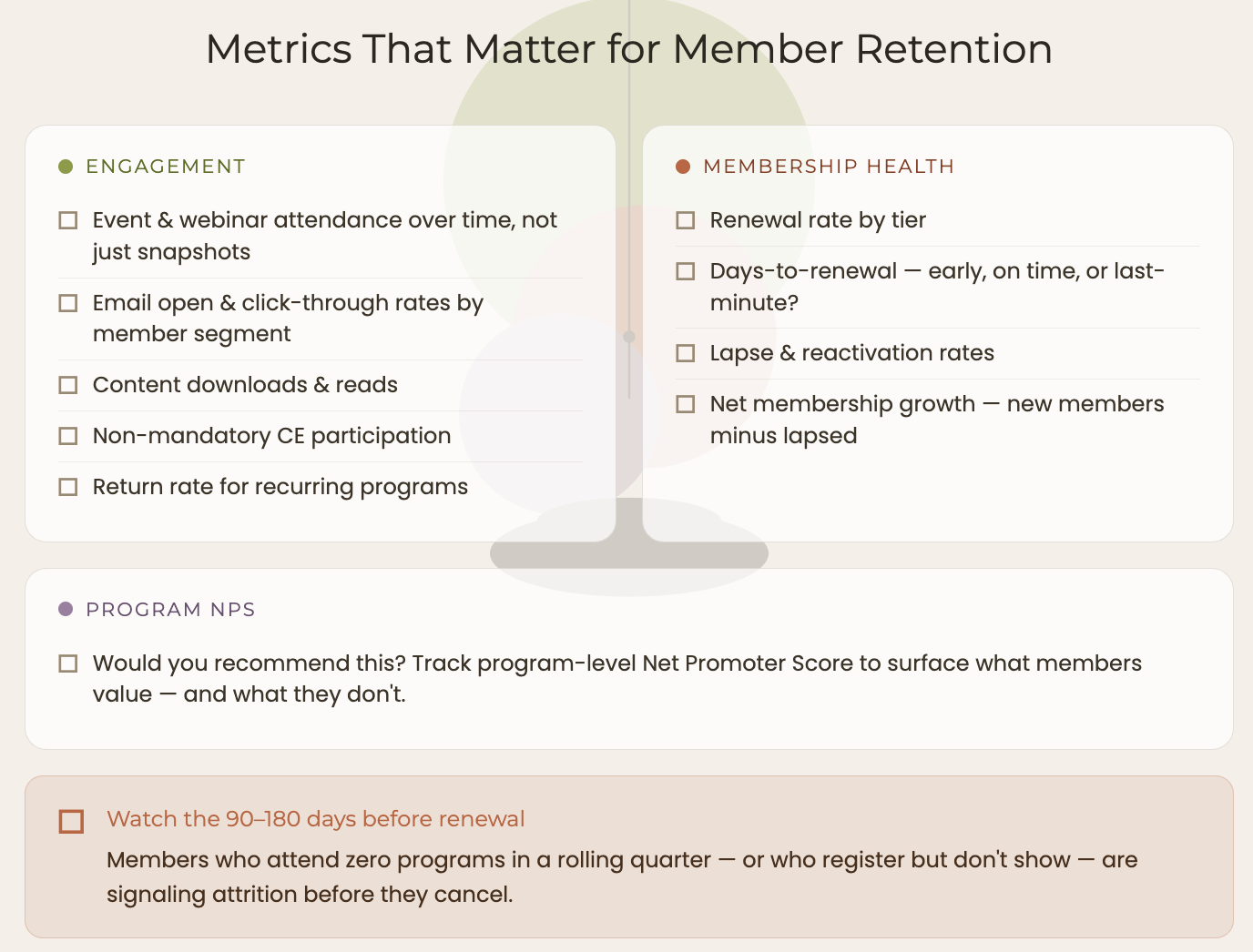
Here's why: declining program engagement is a leading indicator of membership attrition. Before members formally decide not to renew, they disengage. They stop opening emails and attending webinars, or they skip events they used to come to every year. They let their continuing education lapse (unless it's mandated — in which case, that's your floor, not your ceiling).
You can catch this drift only if your membership and programming teams are in constant, ongoing conversation, reviewing every new program initiative together, assessing what is/isn't working, and treating retention as a shared responsibility. That looks like standing conversation embedded into every program proposal, every event brief, every content decision.
Build a Membership Revenue Forecast — and Know Your Levers
Once your program is in place, forecasting membership revenue comes down to two things: your historical retention rate, and the levers available to influence it.
Start with history. What has your retention looked like year over year? What happened in the years where it improved? What happened in the years it dropped? The pattern almost always points to changes in value delivery — a new program launched, an event got worse, pricing increased without a corresponding benefit increase.
Then identify your levers. For an early-stage program, the first lever is awareness: do people even know you exist and that they can join? For an established program looking to grow, the question shifts to market share and adjacencies. Who in your potential market hasn't interacted with you yet? Who might benefit from what you offer who doesn't know about you? Are there adjacent communities, industries, or geographies you haven't reached?
Other common membership levers include:
Pricing and packaging. As we've argued, a single tier forces everyone into the same box. Tiered options, multi-year discounts, group memberships, and trial access each target a different reason someone might not join or stay.
Engagement and onboarding. Members who don't engage in the first 90 days rarely renew. A deliberate onboarding sequence and usage tracking to flag at-risk members before renewal can move that number significantly.
Channel and distribution. Employer sponsorship, partner referrals, and member ambassador programs reach audiences you'd never find through direct marketing alone. Each shifts acquisition away from one-at-a-time and toward cohorts.
Lifecycle management. Lapsed members convert at far higher rates than cold prospects — they already know you and once saw enough value to join. Win-back campaigns and renewal interventions are often the highest-ROI initiatives available.
Value perception. Members frequently underestimate what they're getting. Clearer ROI communication, exclusive access, and a well-timed annual recap can improve renewal rates without changing the program at all.
Structural levers. Credentialing tied to membership creates career-based motivation to stay current. Advocacy functions and peer-organization reciprocity agreements extend value beyond what you can build internally.
Healthy membership growth is almost never about doing more of the same. It requires identifying what needs to change — a new tier, a new market segment, a new benefit — and modeling what that change is realistically worth.
Get Your Governance Right
Membership programs come with more governance complexity than donor tiers, and that complexity needs to be owned at the top.
The Executive Director of a nonprofit with a membership program should think of themselves as the Chief Membership Officer. They hold the member lens in every organizational decision, and make sure that finance, marketing, programming, and events are all operating with the member at the center.
In practice, it means the ED is reviewing membership metrics — renewal rates, engagement trends, net member growth — with the same regularity they review the budget. It means that when the programming team is designing next year's conference, someone in that room is asking, "What does this mean for members?" and has the standing to act on the answer. It means that when finance is modeling next year's revenue, membership isn't a line item someone else owns; instead, the ED can speak to the assumptions behind it.
Without this ownership from the top, teams can't always get a comprehensive view of membership growth. Consider this: the people who are best at membership acquisition often live in development or marketing, or the people who understand member value live in programming. Marketing might be running an acquisition campaign while programming is cutting the benefits that made membership worth joining. No one connected the dots between a dues increase, a reduction in member-only content, and a conference that moved to a less convenient format. An ED with their finger on the membership pulse catches these patterns before they become a trend.
A well-designed membership program is one of the most powerful tools in a nonprofit's toolbox. But it requires the same discipline that any product requires: genuine understanding of what your customer wants, a clear and differentiated value proposition, smart tier structure, and relentless attention to retention signals. When these pieces get put in place, membership becomes a sustaining revenue band for the long haul.
Have questions about building or troubleshooting your membership program? We'd love to talk. Book a call with a Level Nonprofit Pro today.
